Plenty of DTC businesses look strong on paper. Revenue is growing, CAC is on target, ROAS is above benchmark. Then you dig into the details, into the quality of the prospects your growth team is acquiring, the investment being made in media, and the discounts riding along with every order, and you find all three are directly impacting your bottom line in ways the dashboard never shows.
That gap between strong on paper and weak underneath is what actually kills DTC brands. Not competition, not rising media costs. The killer is missing margin intelligence: the ability to see, at the level of customer quality and segments, whether the growth you are buying is worth what you are paying for it.
Why the details stay hidden
Growth teams optimize what they can see, and what they can see is revenue proxies. Platform ROAS, blended CAC, conversion rate. None of those metrics carry margin. They treat a full-price organic customer and a heavily discounted paid prospect as the same revenue when the economics underneath are completely different.
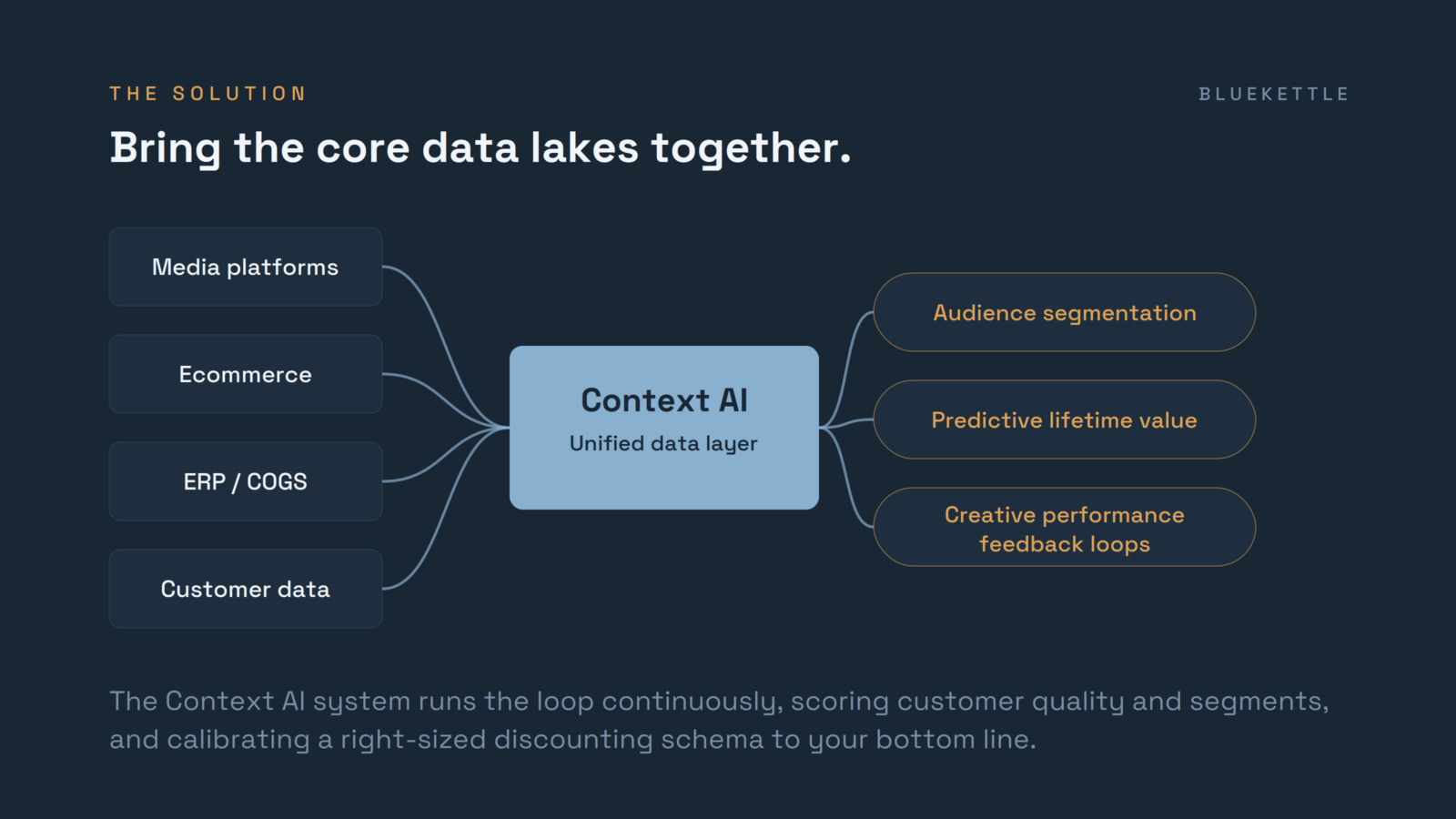
The data to tell them apart exists; it just sits in different core data lakes. Media investment lives in the ad platforms. Orders and discounts live in the ecommerce stack. COGS and fulfillment live in the ERP. Customer history and predicted lifetime value live in the warehouse. Because those lakes never come together in a way a growth team can act on daily, decisions get made on topline numbers instead of bottom-line reality.
This is not a strategy problem or a tooling problem. It is a time problem. No growth team has the hours to join four data sources every morning before deciding where budget goes or which offer runs.
Strong on paper, three ways
Prospect quality. A brand acquires 10,000 new customers at a blended CAC of $42 against a $95 first order. Strong on paper. Dig into the details and 4,000 of those customers came in through a 25%-off prospecting offer and repurchase at 12%, while the full-price 6,000 repurchase at 55%. After the discount, the media investment, COGS, and shipping, the discounted cohort contributes almost nothing and mostly never returns. The blended number says the machine is working. Forty percent of the quarter’s acquisition was revenue with no margin attached.
Media investment. Two customers each place a $120 first order. One found you organically at full price and contributes roughly $55 after COGS and fulfillment. The other clicked a paid ad, used a 25% welcome code, and after the discount and the media spent to acquire them contributes about $4. Your dashboard records two identical orders. Your bottom line experienced two entirely different events, and your bidding algorithms are being trained to go find more of the $4 customer, because that profile converts more readily.
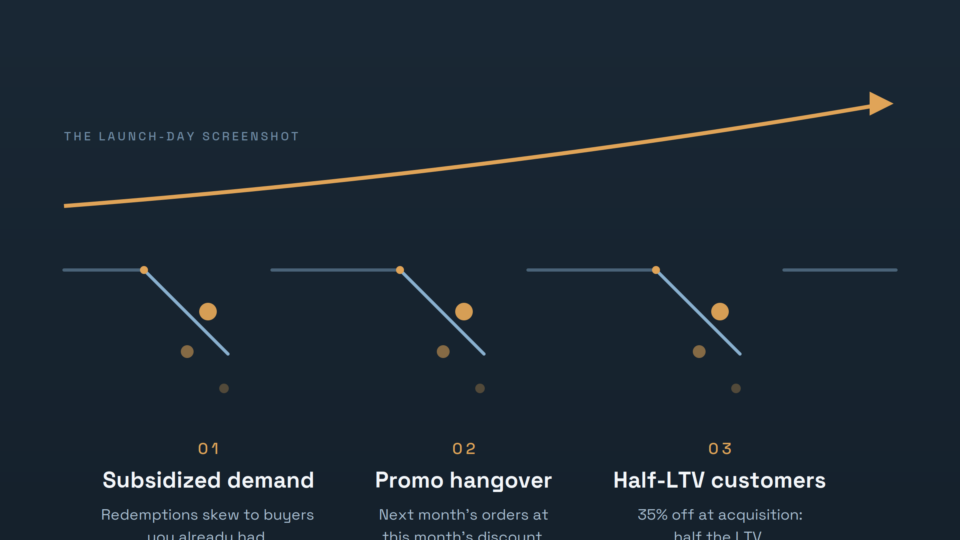
Discounts. Revenue grows 30% year over year. Underneath, discount penetration climbed from 18% of orders to 41%, because every promotion trained more of the base to wait for the next one. Margin per order fell faster than volume grew. The growth is real, it is just being funded directly out of the bottom line, and the habit compounds: each incremental revenue dollar now costs more margin than the last.
In all three cases the topline is true. It is just not what determines whether the business survives.
The solution: bring the core data lakes together
Margin intelligence starts by connecting the lakes, media, ecommerce, ERP, and customer data, so every acquisition and retention decision is scored on contribution margin, not revenue. Once the data is unified, three things become possible:
- Customer quality at the point of acquisition. Channel, creative, offer, and early behavior signals let you score the quality of a prospect the day they convert, not twelve months later when the cohort report confirms what you could have known up front.
- Predictive lifetime value by segment. Quality made measurable turns LTV from one blended number into a distribution across segments. That is what lets you pay up for the customers who deserve it and stop subsidizing the ones who do not.
- A right-sized discounting schema. This is where the margin comes back. Instead of one welcome offer and one promo calendar applied to everyone, discount depth is set by customer quality and segment: full price or minimal incentive where intent and predicted value are high, deeper offers reserved for segments where the discount genuinely changes behavior rather than subsidizing a purchase that was happening anyway. The question shifts from “what offer converts best” to “what is the smallest incentive that wins this customer profitably.”
Why we run this with agents
None of this is a one-time analysis. Segments shift, cohorts mature, offers fatigue. Keeping quality scores, predictive LTV, and discount depth current is continuous, cross-system work, exactly the work growth teams do not have time for.
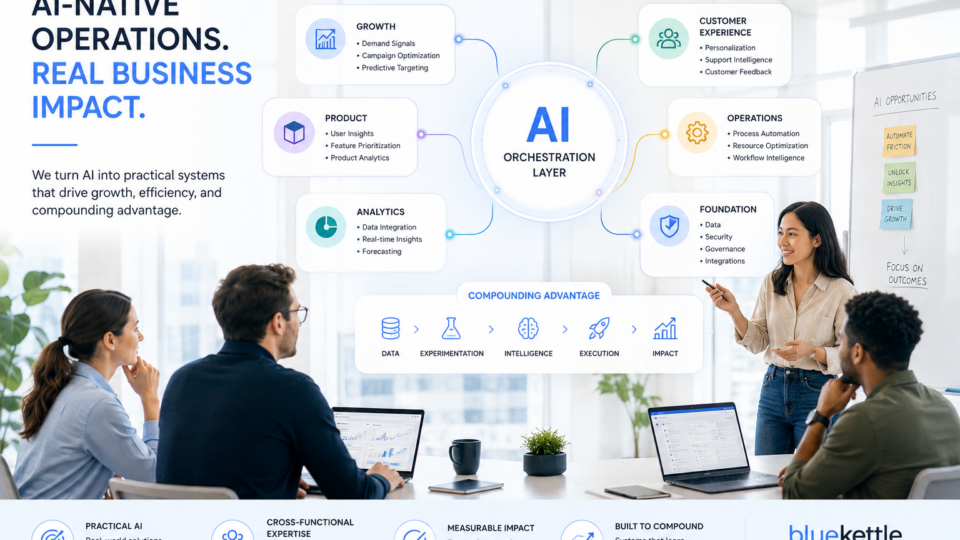
That is where Bluekettle’s AI agents come in. They sit on the unified data layer and run the loop: audience segmentation keeps customer quality current, predictive lifetime value re-ranks segments as new data lands, and creative performance feedback loops steer media investment toward the segments that carry margin, not just the ones that click. The result is not another dashboard. It is a repeatable, adaptable acquisition and retention system, grounded in lived growth marketing experience rather than bolted-on automation, where discounting, targeting, and spend are calibrated to the bottom line by default.
The question worth asking
Strip the discounts, media investment, COGS, and fulfillment out of last quarter’s new customer revenue, segment by segment. How much of your growth is still there?
Most brands cannot answer that today. If you want to see what your acquisition actually looks like on a contribution margin basis, talk to us. The first thing we do is bring the data lakes together. The second is show you where the margin went.